Digital Tool Framework
I owned the design of one reusable system behind 53 interactive assessments and calculators, localized into 26 markets. Instead of building each tool from scratch, marketing could launch new ones on a shared framework and see roughly 10x the conversion of other on-site paths.
The AP Process Risk Assessment tool, one of 53 live tools built on the shared JSON content and scoring framework.
Overview
At SAP Concur, I owned the UX for a portfolio of interactive marketing tools: risk assessments, ROI calculators, policy builders, and a finance personality quiz, deployed across the company's global commercial sites.
The role sat between design, engineering, and marketing: I designed the tools themselves, but I also designed the framework that let the team keep building them without a developer on every project.
Every tool, a one-off build
Concur's commercial site leaned on generic gated content and static forms to capture leads. Every new interactive tool, an assessment, a calculator, was a one-off build: custom logic, custom templates, a new developer ticket.
The business case was straightforward: interactive tools that gave visitors something useful back (a risk score, an ROI estimate, a benchmark against peers) converted better than a plain "download this whitepaper" form.
Good tool ideas died in a backlog because dev capacity couldn't keep up. Every format needed bespoke engineering before it could be tested at all.
The tools that did ship were expensive to localize, which meant most of the portfolio's value stayed locked in English-language, US-only markets.
Research & discovery
Three years of rep-guided data
Sales had been using ROI Shop, a rep-guided ROI calculator, for three years, walking prospects through it live on the phone. That told me what inputs and logic a self-serve version needed to carry, without a rep in the loop to explain edge cases.
Discovery across three functions
Sessions with sales, legal, and regional marketing pressure-tested which assumptions could be exposed to users directly versus defaulted and hidden.
Format-to-funnel fit
The same sessions worked out where in the funnel each tool type (assessment, calculator, builder, quiz) made sense, rather than treating them as interchangeable.
Tool-by-tool performance
Landing page traffic, question completion, results reached, and conversion at each step, quarter by quarter. That funnel view told me which formats deserved more design effort and which were quietly underperforming.
The core design decision was to stop treating each tool as a one-off.
A JSON content and scoring framework
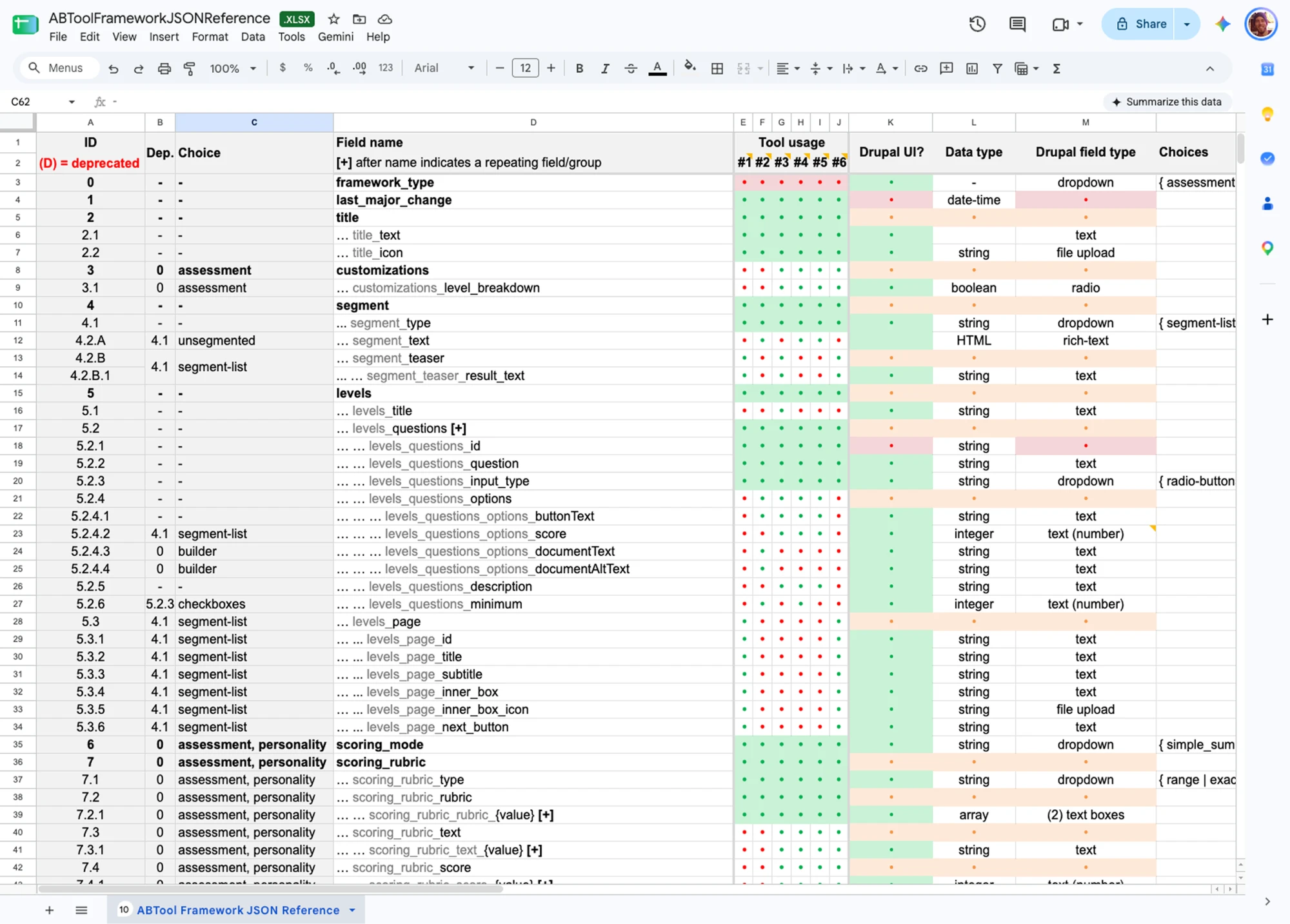
I separated a tool's logic, its questions, branching, weighted scoring, from its front-end template. A marketing author could configure a new assessment, builder, or personality quiz through the Drupal UI, choosing input types, point values, and result thresholds, without a new development cycle for each one. I documented the framework as a field-by-field reference so authors and developers were working from the same model.
Reusable scoring models
Standardized models on top of the framework: simple point totals for assessments, weighted archetype scoring for the personality quiz. Reused rather than redesigned from scratch each time.
Prototypes for novel behaviour
For anything with new interaction behaviour, like the VAT calculator's synced slider-and-input controls, or the difference between a "cookied" returning visitor skipping straight to results and an "uncookied" visitor hitting a lead capture form first, I prototyped in HTML/CSS/JS so engineering had something to build against rather than a static comp.
QA specs before launch
Default, min, and max values for every input, and expected behaviour at each edge case, so testing caught logic errors before launch, not after.
One framework, fifty-three tools
A portfolio of 53 live tools across four formats, localized into 26 markets, all running on the same underlying framework.
The portfolio
Travel Risk Assessment and AP Process Risk Assessment, Expense and Invoice ROI Calculators, an Expense Policy Builder, a VAT/tax reclaim calculator, and "What Kind of Finance Manager Are You?", a personality quiz that scored respondents into one of four archetypes (Builder, Commander, Guardian, Hero) and benchmarked them against other respondents.
The pattern, end to end
The VAT reclaim calculator: a six-step wizard combining industry-benchmark defaults (international flight deductions, non-VAT country spend, typical receipt disqualification rates) with a handful of user inputs, then generating a downloadable PDF estimate. On a default scenario, over $1.6M in estimated annual reclaim potential.
The ask comes after the value
The lead capture form only appeared for new visitors, and only after they'd already engaged with the tool. Returning visitors went straight to their results.
One tool from the portfolio
The self-serve descendant of ROI Shop: the same inputs and logic sales had been walking prospects through on the phone, carried into a tool a visitor could finish alone.
View the live tool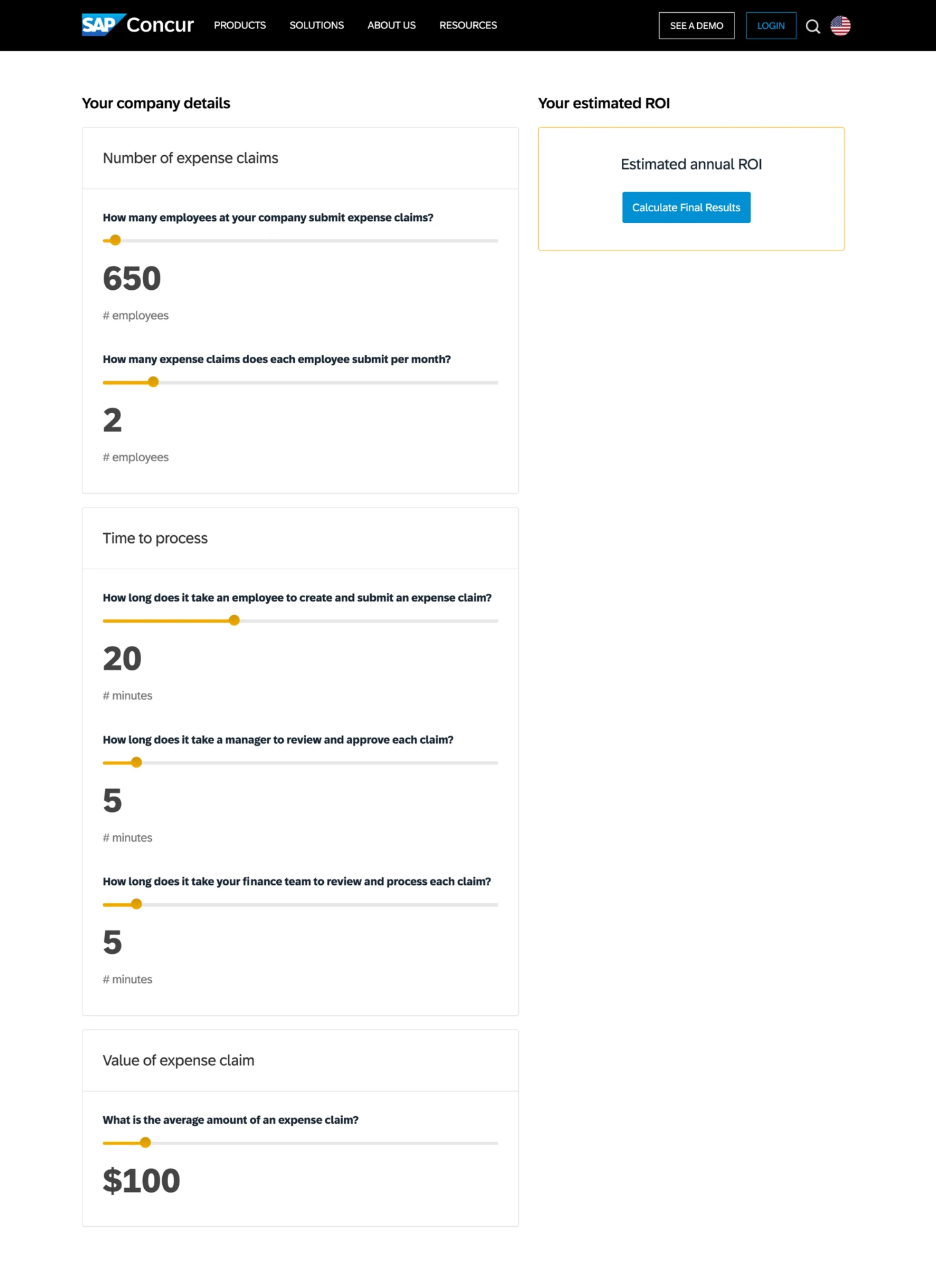
Impact & results
Conversion rates across the digital tools portfolio ran roughly 10x higher than other on-site conversion opportunities. The tool-level data is what makes the case for the framework specifically.
Higher conversion than other on-site conversion opportunities
Inquiries per quarter for the finance personality quiz, with a 5.39% completion-to-inquiry rate
Quarter-over-quarter inquiry growth for the Travel Risk Assessment tool
Once the JSON model was in place, new tools could reach dozens of localized variants without a proportional increase in dev or localization cost, which is how the portfolio scaled to 53 live tools across 26 markets in the first place. My work was recognized internally with a 2019 SAP Marketing Excellence Award and selection into SAP's Catalyst leadership program, a competitive development track for the top 10% of employees.
What I'd do differently
The framework's biggest strength, pushing tool logic into JSON so marketing authors could configure new tools themselves, was also its biggest onboarding cost. Authors needed real training to work confidently in a system that traded a friendlier visual builder for more powerful, more abstract configuration. I'd invest earlier in structured documentation and training for non-technical authors rather than letting that knowledge live mostly with me and the dev team.